Why Was En Passant Created? The Most Unusual Rule in Chess
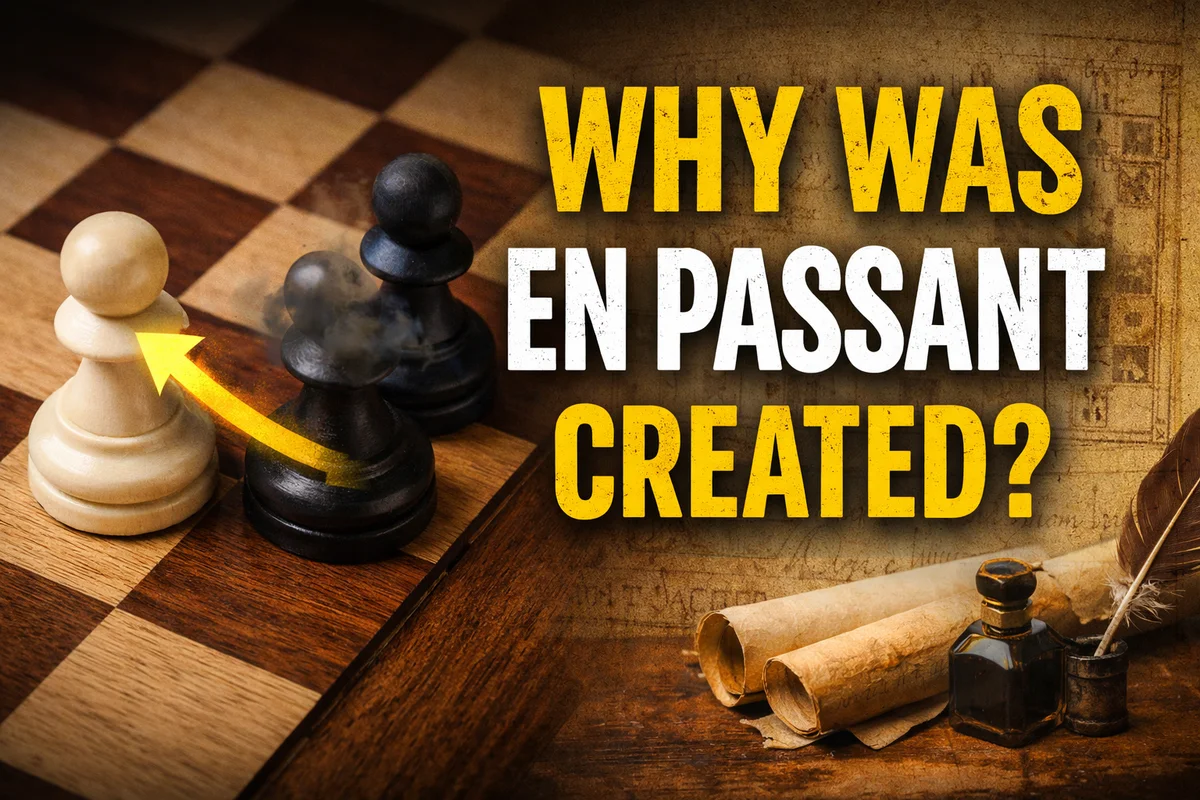
Why Was En Passant Created?
Among all the rules in chess, en passant stands out as one of the most unusual and often misunderstood. Many beginners are surprised when they first encounter it, and some even question why such a strange rule exists in the first place.
However, en passant is not random at all. It was carefully designed to solve a specific problem and maintain fairness in the game.
The Origin of En Passant
The rule of en passant was introduced in the late 15th century, during a period when modern chess rules were beginning to take shape in Europe.
Before this time, pawns could only move one square forward. But as the game evolved, a new rule was added: pawns were now allowed to move two squares forward on their first move. This change made the game faster and more dynamic.
While this new rule improved the pace of the game, it also created an unexpected problem.
The Problem It Solved
With the ability to move two squares, a pawn could effectively escape a capture that would have been unavoidable under the old rules.
For example, if a pawn moved only one square and landed next to an opponent’s pawn, it could be captured normally. But by jumping two squares, it could bypass that danger entirely.
This was seen as unfair, because the pawn was essentially “skipping” a square where it could have been captured.
To fix this issue, en passant was introduced.
How En Passant Works
The rule allows a pawn to capture an opponent’s pawn as if it had only moved one square, even though it actually moved two.
The conditions are very specific:
- The opponent must move a pawn two squares forward in one move
- Your pawn must be positioned next to the square it passes through
- The capture must be made immediately on the next move
If the opportunity is not taken right away, the right to capture en passant is lost.
Why This Rule Matters
At first glance, en passant may seem like a minor or rarely used rule. However, it plays an important role in preserving the logic and integrity of chess.
Without it, pawns would have a way to avoid interaction unfairly, which could change the balance of the game. By including en passant, the rules ensure that the two-square pawn advance does not break the fundamental principles of pawn play.
The exact conditions
The rule is narrow, and most disputes about it come from ignoring one of the conditions:
- The opponent's pawn must move two squares in one move, from its starting rank.
- Your pawn must be on the fifth rank (for White) or the fourth rank (for Black), adjacent to the pawn.
- The capture must be made immediately, on the next move.
- The capturing pawn moves to the square the opponent's pawn passed over, and the captured pawn is removed.
If any of those conditions is missing, en passant is not available. The right cannot be saved for later.
A concrete example
White has a pawn on e5. Black plays ...d7–d5, trying to avoid the capture that would have followed ...d7–d6. White can now play exd6 en passant: the white pawn moves to d6, and the black pawn on d5 is removed. The move is legal only on that turn.
The position is easy to verify in a FEN editor. Set up the pawns, make the double move, and check that the en passant target square appears in the fourth field of the FEN. If the field is -, the right has already expired.
Why the rule is still argued about
Because it is the only capture in chess where the capturing piece does not land on the square occupied by the captured piece, beginners often believe it is illegal or a bug in the software. It is neither. The rule has been part of the game for centuries and is enforced in every official event.
The practical lesson is simple: when a pawn moves two squares and lands beside an enemy pawn, check for en passant before doing anything else. Missing it is a common source of unnecessary losses at club level, and the puzzle trainer includes positions where the threat of en passant is the point of the tactic.
Conclusion
The en passant rule was created not to complicate chess, but to protect its fairness. It ensures that even with new mechanics, like the two-square pawn move, the game remains consistent and balanced.
While it may feel unusual at first, understanding en passant reveals something deeper about chess: every rule exists for a reason, and even the smallest details can have a significant impact on the game. ♟️
Continue reading
Chess
Chessions Chess Puzzles Guide: How to Train Tactics, Climb Your Rating, and Reach the Leaderboard
Complete guide to the Chessions Chess Puzzles trainer: learn how adaptive Elo puzzle ratings, interactive Chess Coach feedback, hints, solutions, streaks, and the global 1200+ leaderboard work.
Chess
How to Create Chess Videos Fast Using Templates, Template Preview, and Simple Mode
Learn how to turn analyzed chess games into polished MP4 videos for TikTok, YouTube Shorts, and Instagram Reels using Chessions Video Templates, Template Preview with Main Move mapping, and Simple Editor Mode.
Chess
How to Import and Analyze Chess Games Online with Stockfish on Chessions
Learn how to import finished chess games from Chess.com, Lichess, or raw PGN and FEN on Chessions, then run free browser-based Stockfish analysis with accuracy scores and move classifications.