Is Chess Bigger Than the Universe? Understanding the Shannon Number
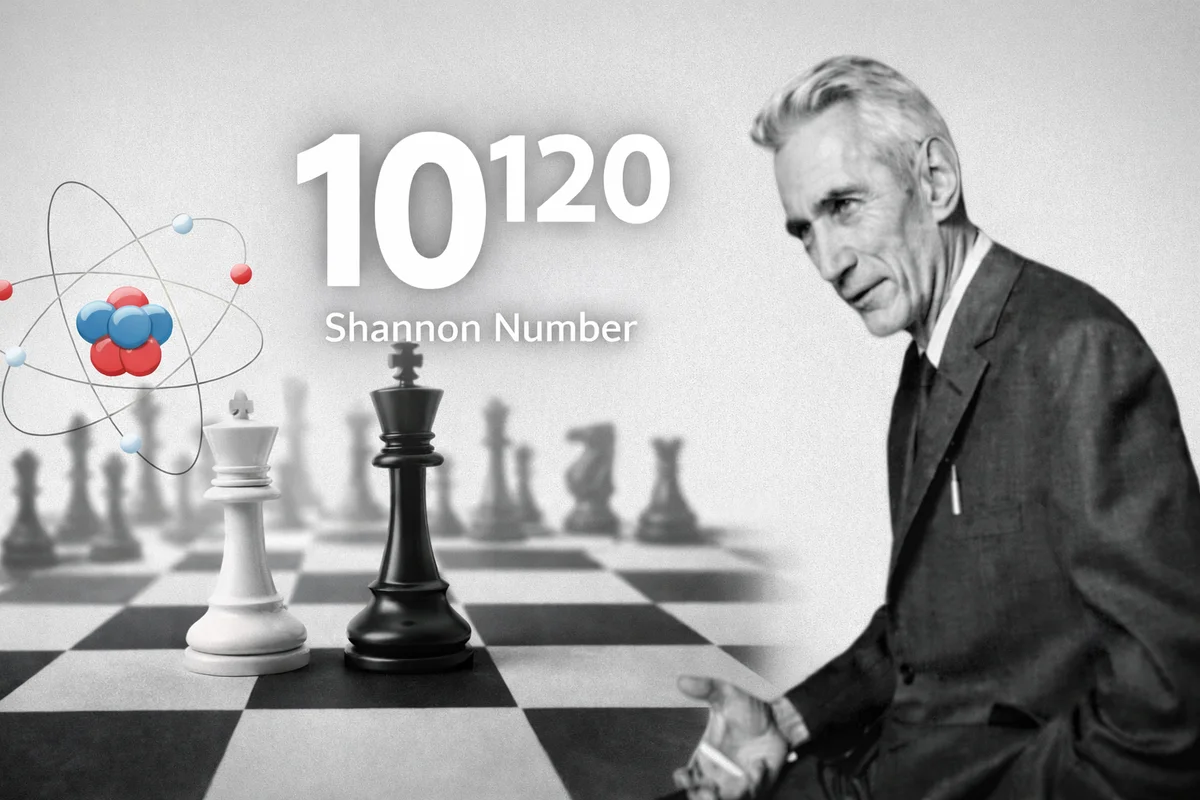
Is Chess Bigger Than the Universe? Understanding the Shannon Number
At first glance, chess seems deceptively simple. The stage is restricted to an 8x8 grid of 64 alternating black and white squares. There are only 32 pieces on the board at start, and each piece obeys strict, unwavering laws of movement. Yet, within these boundaries lies a mathematical labyrinth so vast that it dwarfs the physical scale of the cosmos.
To describe this complexity, mathematicians and physicists often look to a threshold known as the Shannon Number. First calculated in the mid-20th century, this estimate suggests that there are vastly more unique games of chess possible than there are physical atoms in the observable universe.
Here is how the mathematics of a simple board game outgrew the universe.
The Scale of the Cosmos: $10^{80}$ Atoms
To understand how chess compares to the universe, we first need to look at the scale of the physical world. Astronomers and physicists calculate the number of atoms in the observable universe—everything we can see, touch, or detect with instruments—to be approximately $10^{80}$.
To put $10^{80}$ in perspective:
- A single grain of sand contains about $10^{19}$ atoms.
- The entire planet Earth contains roughly $10^{50}$ atoms.
- Our Sun contains about $10^{57}$ atoms.
If you add up every star, every planet, every gas cloud, and every speck of cosmic dust in billions of galaxies across the known universe, the total reaches around $10^{80}$ atoms. For decades, this number has served as the ultimate scientific benchmark for "astronomically large."
Entering the Game Tree: Claude Shannon’s Math
In 1950, Claude Shannon—an American mathematician widely considered the father of information theory—published a paper titled "Programming a Computer for Playing Chess". In it, Shannon sought to calculate the computational difficulty of programming a machine to play chess.
To do this, he estimated the number of possible games. He observed that:
- In an average position, a player has about 35 legal moves.
- A typical game of chess lasts roughly 40 moves for each side (amounting to 80 half-moves or plies).
If you start multiplying the possibilities at each turn ($35 \times 35 \times 35 \dots$ eighty times), the numbers grow exponentially. Shannon concluded that the number of unique chess game paths is approximately:
$$\mathbf{10^{120}}$$
This is the Shannon Number.
Comparing the Scales: $10^{120}$ vs $10^{80}$
When we look at $10^{120}$ and $10^{80}$, it is easy to assume they are close because the exponents look similar. However, logarithmic scales are deceptive.
The difference between $10^{120}$ and $10^{80}$ is $10^{40}$—that is a 1 followed by 40 zeros.
To put that scale into perspective, if every single atom in our observable universe was itself an entire universe containing another $10^{80}$ atoms, the total number of atoms in all those universes combined would still only be $10^{160}$. The number of chess variations is so staggeringly large that the physical cosmos does not have enough raw matter to represent them.
Positions vs. Games: The $10^{43}$ Estimate
It is important to make a distinction between the number of possible chess games and the number of unique legal board positions.
Dutch computer scientist Victor Allis calculated that the number of unique, legal board positions (arrangements of pieces on the 64 squares) is around $10^{43}$. While $10^{43}$ is significantly smaller than $10^{120}$, it is still a massive number—exceeding the number of drops of water in all the oceans on Earth.
The reason the number of games ($10^{120}$) is so much larger than the number of positions ($10^{43}$) is transposition. Multiple different sequences of moves can lead to the exact same board position. For example, White opening with 1.e4 followed by 2.Nf3 leads to the same position as 1.Nf3 followed by 2.e4.
Why Chess Remains Unsolved
The enormous complexity of the Shannon Number is the reason why chess has never been "solved" by computers.
In simpler games like Tic-Tac-Toe, a computer can easily calculate every possible line to the end and play perfectly. In chess, even the most powerful supercomputers cannot brute-force their way through a game tree of $10^{120}$ paths.
This is why modern chess engines like Stockfish do not try to look at everything. Instead, they rely on pruning algorithms (to discard bad branches immediately) and neural evaluation networks (to estimate the quality of a position without calculating it to checkmate).
Every single time you sit down to play a game of chess, the path you walk is almost certainly unique. After just a few moves, you and your opponent are navigating a combination of pieces that has likely never been seen by any human, engine, or star in the history of the universe.
Continue reading
Chess
Chessions Chess Puzzles Guide: How to Train Tactics, Climb Your Rating, and Reach the Leaderboard
Complete guide to the Chessions Chess Puzzles trainer: learn how adaptive Elo puzzle ratings, interactive Chess Coach feedback, hints, solutions, streaks, and the global 1200+ leaderboard work.
Chess
How to Create Chess Videos Fast Using Templates, Template Preview, and Simple Mode
Learn how to turn analyzed chess games into polished MP4 videos for TikTok, YouTube Shorts, and Instagram Reels using Chessions Video Templates, Template Preview with Main Move mapping, and Simple Editor Mode.
Chess
How to Import and Analyze Chess Games Online with Stockfish on Chessions
Learn how to import finished chess games from Chess.com, Lichess, or raw PGN and FEN on Chessions, then run free browser-based Stockfish analysis with accuracy scores and move classifications.